Detailed guide
Quick answer
GOV.UK currently says you will usually get the grant of probate or letters of administration within 12 weeks of submitting your application.
That is only the application-processing stage. The full executor timeline can be longer because you may need to gather estate values, check inheritance tax, prepare the application, collect assets after the grant, pay debts, prepare estate accounts, and distribute safely.
For a straightforward estate, the whole administration often still runs for many months. More complex estates can take much longer. The reason is simple: the legal application is only one part of a wider process that starts with fact-finding and ends with final accounts and distribution.
If you only ask "how long does probate take?", you usually get an incomplete answer. The better question is: how long will it take to prepare, obtain, and then use probate properly?
Where the time really goes
Most of the timeline sits in four broad phases.
1. Early fact-finding
This is the stage people underestimate most.
Executors often need time to:
- locate the will and confirm who is acting
- register the death and order certified copies
- identify all known assets and liabilities
- ask institutions for date-of-death values
- gather paperwork for property, pensions, investments, and debts
If the estate information is incomplete at this point, the rest of the timeline usually slows down with it.
2. Tax checks and application preparation
Before a probate application is ready, the executor may need to:
- work out whether inheritance tax is in point
- decide whether the estate is excepted or needs fuller reporting
- arrange funding for any tax due before a grant can be issued
- make sure names, dates, figures, and documents line up
For some estates, especially those using the IHT400 route, this stage is where a lot of real time is spent.
3. The court or registry wait
Once the application is submitted, there is still a waiting period while the Probate Registry or court processes it. GOV.UK currently says applicants will usually receive probate or letters of administration within 12 weeks.
That waiting time can stretch if:
- documents are missing
- details are inconsistent
- the registry asks questions
- tax steps were not completed cleanly first
- the will, codicils, or executor position need clarification
This is why a rushed application often does not save time overall.
4. Collection, payment, and final administration
Even after the grant arrives, there is still substantial work left:
- collecting money from institutions
- selling or transferring property
- paying debts, tax, and administration expenses
- dealing with estate income during the administration period
- preparing estate accounts
- distributing only when it is safe to do so
For many families, this post-grant stage is longer than they expected.
A realistic way to think about the full timeline
If you want a simple mental model, think in terms of:
- weeks to gather the picture
- further time to get the tax and application ready
- a separate waiting period for the grant, currently usually within 12 weeks after submission
- more months to finish the administration properly
In practice, many straightforward estates still run for many months, often around 6 to 12 months end to end, and longer where there is property, tax complexity, delay from institutions, or disagreement between those involved. That is a practical planning range from the stages involved, not a fixed statutory timetable.
Common reasons probate takes longer
Missing or late valuations
Property, investments, and harder-to-trace assets can slow everything down if values are not confirmed early.
Unclear executor position
Problems over who is acting, who is stepping back, or whether there is a valid will can hold the application up.
Inheritance tax work done late
If the tax position is not settled early, the probate application can stall or need correcting.
Property issues
Questions over ownership, title, insurance, or sale timing often make estate administration longer than families expected.
Slow responses from institutions
Banks, pension providers, insurers, registrars, and utility providers all move at their own pace.
Records that do not match
Small inconsistencies in names, addresses, account references, or dates can create avoidable follow-up queries.
What actually helps
Executors usually save the most time by being organised rather than by trying to rush the formal application.
The habits that help most are:
- build a complete asset and liability list early
- keep evidence with the record it supports
- note which assets are joint and which are sole-name
- resolve tax questions before submitting the application
- track every open request so you know who still owes you information
- do not treat the grant as the finish line
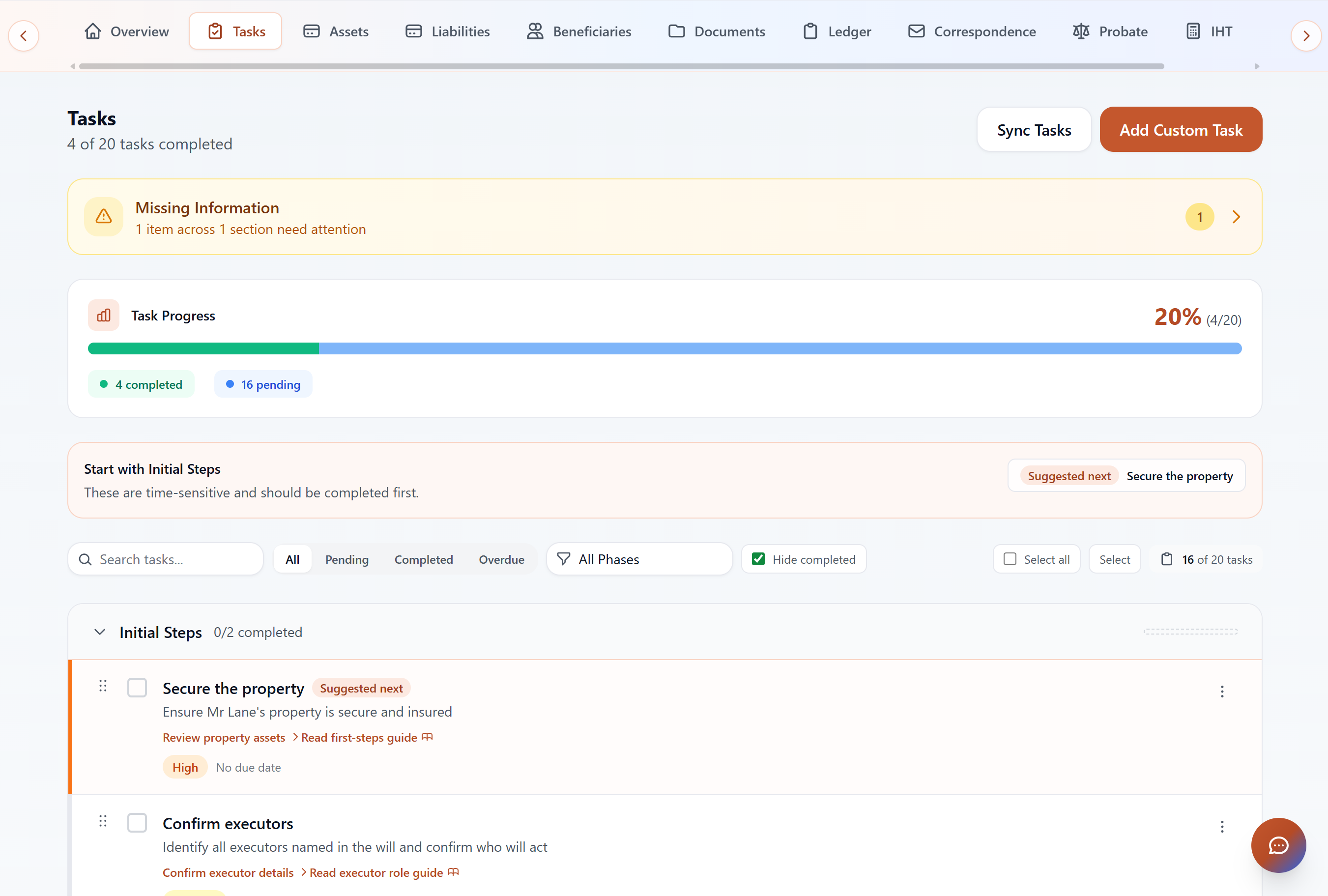
Estate Suite is designed around those habits: tasks, assets, liabilities, documents, inheritance tax preparation, correspondence, ledger entries, and estate account exports stay in one estate record.
If you are still at the start, read What to Do After a Death: First Steps for Executors. If you are trying to place the probate stage in context, read How to Apply for Probate in England and Wales.
When a delay is a warning sign
Some delay is normal. A probate process should feel cautious and evidence-based. But some delays suggest a genuine problem rather than ordinary administration time.
Pay closer attention if:
- you still do not have a clear asset picture after repeated enquiries
- there is disagreement about the will or who should act
- debts may exceed assets
- the estate has foreign, trust, or business elements
- you have submitted information and then discovered material errors
Those are usually points to pause, re-check the position, and consider specialist advice.
FAQ
How long does probate take in the UK?
GOV.UK currently says you will usually receive probate or letters of administration within 12 weeks of submitting the application. The full estate administration timeline can still take months because executors also need to gather values, check tax, collect assets, pay debts, prepare estate accounts, and distribute safely.
How long does it take to get the grant itself?
GOV.UK currently says the grant is usually received within 12 weeks after submission. The application processing period still depends in part on how complete and straightforward the application is when it reaches the registry.
Can probate be finished in a few weeks?
Very rarely from start to finish. Even simple estates need time for fact-finding, tax checks, and post-grant administration.
Is the estate finished once probate is granted?
No. The grant usually gives authority to move into collection, payment, accounting, and distribution. It does not finish the estate by itself.